
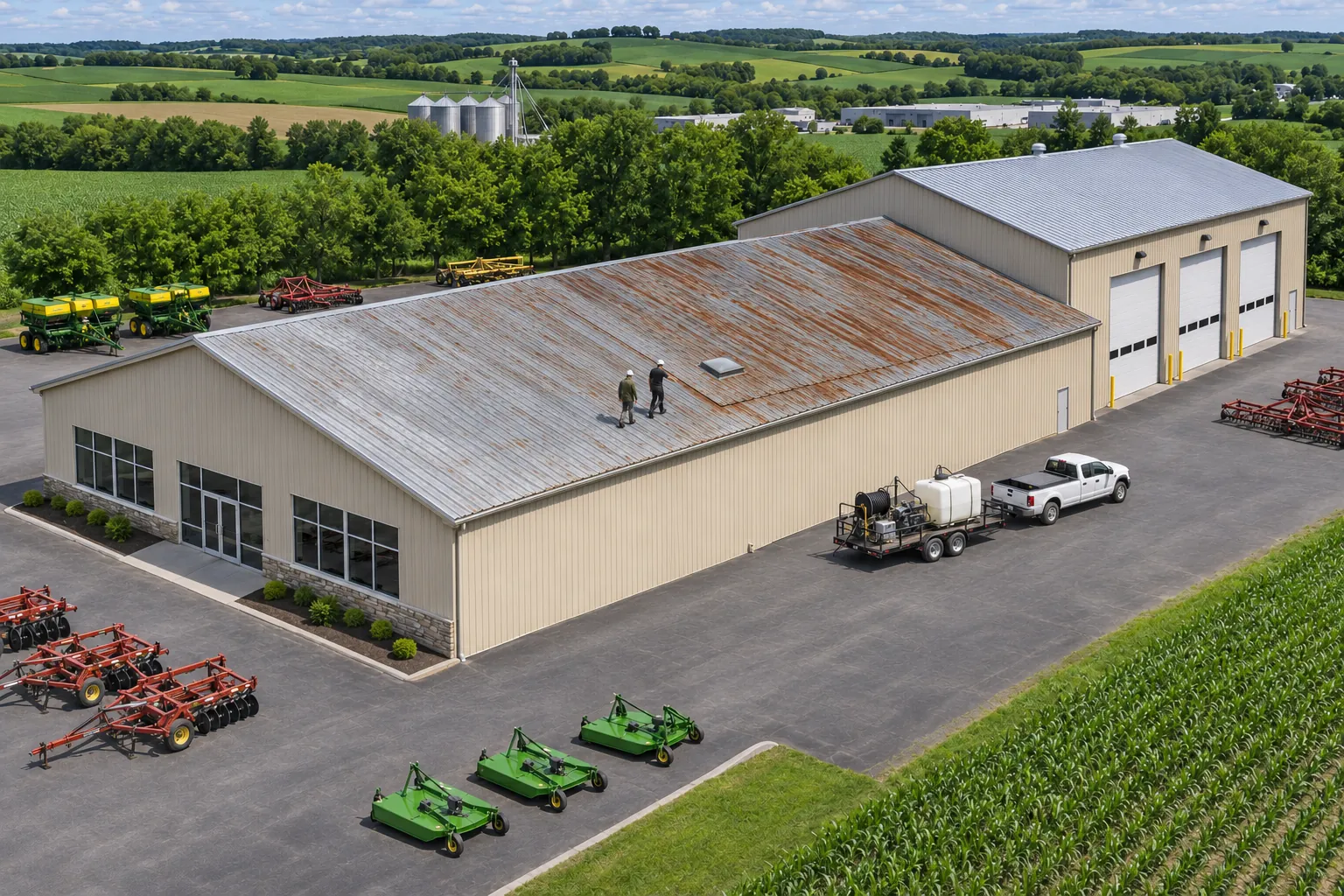
Metal Roof Coating Questions in Lancaster
Straight Answers on Rust, Systems, Weather, and Cost
These metal roof coating questions in Lancaster come from building owners deciding whether to coat, repair, or replace a commercial roof.
Browse Metal Roof Coating Questions in Lancaster by Topic
Metal roof coating questions in Lancaster fall into six groups. Pick a topic to jump to its answers.
Coating Or Replacement
Can an agricultural metal roof with surface rust still be coated?
An agricultural roof with surface rust may still be a coating candidate if the panels and their connections remain sound. We investigate corrosion around overlaps and fasteners rather than judging only the visible discoloration.
Metal loss, trapped moisture or weak attachment must be addressed before the proposed finish can be considered.
Should badly corroded roof panels be coated or replaced?
Badly corroded panels need replacement evaluation where remaining metal cannot support reliable attachment or weatherproof details. We compare damage across the roof before defining which sections can stay.
Coating may still suit sound areas, but a surface finish cannot restore the strength of perforated or substantially weakened panels.
How should rust hidden inside panel laps be prepared?
Rust inside panel laps needs enough investigation to determine whether the metal and joint remain repairable. We assess access for removing loose corrosion and applying compatible treatment rather than coating only the visible edge.
Where deterioration has damaged the overlap itself, the restoration scope may need panel work before surface preparation.
Can roof age alone tell us when spray foam needs replacement?
Roof age alone cannot establish whether spray foam needs replacement. We investigate moisture, damage to the foam and deterioration of its protective surface before judging serviceability.
Local repairs and compatible recoating may be appropriate where sound material remains, while wet or extensively damaged areas need a different scope.
When should a commercial owner choose new shingles instead of coating?
New shingles deserve consideration when curling, brittleness or widespread loss of material has compromised the covering. We inspect the deck and flashing to understand the full replacement need.
Coating cannot renew failed shingles, and even a compatible treatment should not distract from moisture or ventilation problems affecting the assembly.
Choosing A Coating System
Does one coating chemistry always last longer on commercial metal roofs?
No coating chemistry has a dependable longevity advantage on every commercial metal roof. We choose among suitable systems by considering drainage, substrate compatibility, preparation and the maintenance environment.
A carefully selected finish still needs correct thickness and sound seam details; the product name cannot compensate for deterioration underneath.
Would silicone work better than acrylic near slow-draining roof sections?
Silicone may be a candidate where its product specification supports the moisture conditions, but drainage still needs investigation. We compare the actual silicone and acrylic systems after checking low spots, outlets and existing finishes.
Neither choice should be used to conceal wet insulation or substitute for correcting defective runoff paths.
What makes a farm building’s metal roof suitable for acrylic?
Acrylic needs sound, compatible metal with proper preparation and drainage suited to the selected system. We examine rust, old finishes and moisture beneath the covering before discussing application.
On farm buildings, ventilation and condensation also deserve attention so an exterior finish is not mistaken for a solution to indoor moisture.
Which coating is appropriate for shingles on a commercial church building?
A church shingle coating needs explicit support from the actual products’ instructions before any material is selected. We examine shingle condition, ventilation and flashing alongside that guidance.
A finish recommended for another roof surface does not establish compatibility, and deterioration may make replacing shingles more suitable than treating them.
What controls coating life on a food processing plant’s roof?
Coating life on a food processing plant depends on preparation, film thickness and the exposure created by equipment and maintenance. We examine exhaust areas, access routes and seams that move under changing temperatures.
Continued upkeep matters, but the condition of those details cannot be converted into a promised lifespan.
What are the drawbacks of foam roofing above active food processing?
Foam roofing above active processing needs control of overspray, intake exposure and access during application. We also consider future protection from traffic and maintenance of the coating over the foam.
The assembly may provide insulation and a continuous surface, but those benefits do not remove application limits or the need for ongoing repairs.
Coats, Preparation, And Repairs
How is the required silicone coat count established?
The selected silicone specification establishes the required film thickness and application method, which determine coat count. We account for ribs, repairs and reinforced details when checking coverage.
A stated number of coats is incomplete without the intended finished film and suitable preparation of the metal receiving the material.
Does acrylic need several coats to protect exposed roof ribs?
Acrylic needs the specified finished thickness over roof ribs, whether the product achieves that through several passes or another permitted application method. We check coverage and drying between coats under the manufacturer’s instructions.
The protective result depends on adhesion and complete film formation rather than counting visible applications alone.
Which maintenance findings suggest a silicone finish is wearing out?
Exposed substrate, lifting edges and deteriorating details can indicate that a silicone finish needs attention. We check whether damage is local or spread across the coating before selecting repairs.
Its remaining service depends on adhesion, drainage and roof use, so appearance and age alone should not dictate a recoating decision.
What must be repaired before recoating a weathered foam roof?
Damaged foam, punctures and unsuitable wet areas must be addressed before a weathered foam roof receives new protective coating. We inspect old repair boundaries and adhesion as well as the exposed surface.
Renewing the finish should follow those repairs, not leave concealed moisture or unstable material beneath a fresh appearance.
What belongs in a metal roof restoration for a tobacco warehouse?
A tobacco warehouse restoration should address panels, fastening, seams and roof-to-wall flashing before the coating layer is applied. We also examine moisture beneath old repairs and the condition of adjacent brickwork.
The scope needs to distinguish retained metal from replaced details so the finish connects to a dependable prepared assembly.
Weather And Building Conditions
Can frozen gutters create leakage beneath otherwise sound roof panels?
Frozen gutters can hold snowmelt against vulnerable roof edges or laps, allowing water to enter around otherwise sound panels. We inspect those routes after safe access becomes possible.
Freeze-thaw cycles can aggravate existing joint defects, while heavy wet snow requires separate consideration of structural loading rather than reliance on coating condition.
Should summer storm inspections include coated roof edges?
Coated roof edges should be included after summer storms because wind can disturb flashing and hail can damage exposed details. We inspect attachment, split metal and punctures before recommending more coating.
A sound-looking central roof area does not show whether water can enter at displaced perimeter components.
Could humidity inside a brick tobacco warehouse complicate restoration?
Indoor humidity can complicate restoration when condensation or damp insulation is mistaken for leakage through the outer roof. We compare operating conditions with rain-related staining and inspect roof-to-brick transitions.
The coating proposal should address the actual roof condition while ventilation or masonry defects receive separate attention where needed.
Why can acrylic coating deteriorate unevenly across a metal roof?
Acrylic can wear unevenly where film thickness, moisture exposure or service traffic differs across the roof. We inspect ribs, repaired seams and equipment routes to distinguish ordinary surface wear from an underlying defect.
Maintenance decisions should follow those findings, since a single age estimate does not describe every section’s condition.
Cost, Planning, And Code Review
Is coating worth considering for a Lancaster equipment building?
Coating is worth considering when a Lancaster, PA equipment building has serviceable panels that can be prepared and repaired appropriately. We weigh the extent of existing defects against the work needed to leave a suitable base.
The decision should include future access and maintenance, without treating restoration as an assumed financial saving.
How should a commercial shingle coating budget be assessed?
The budget must first establish that the shingles and coating are compatible. Planning figures are about $2.50 to $4.00 per square foot of roof for coating and about $5 to $8 per square foot for replacement.
We consider size, access, coating type, thickness, coats, penetrations, flashing and fastener sealing, with rust and seam preparation where applicable. Unsupported shingle applications should not be priced as viable work.
What should coating quotes include for a Lancaster metal roof?
A Lancaster, PA coating quote should cover preparation and the specified application, using about $2.50 to $4.00 per square foot of roof as the coating range. Replacement is about $5 to $8 per square foot.
We assess roof size and access, rust and seam preparation, fastener sealing, coating type and thickness, coat count, penetrations and flashing before defining the building’s actual scope.
How can roof preparation be coordinated around farm equipment storage?
Roof preparation should be coordinated so equipment and access routes beneath the work receive appropriate protection. We discuss cleaning, material movement and any opening of damaged panels before choosing a sequence.
A farm building that remains in use may need temporary isolation in selected areas, especially where stored machinery sits directly below repairs.
What information helps a Lancaster coating project receive code review?
A Lancaster, PA coating review benefits from a description of the existing roof, intended preparation and any replacement components. We make the distinction between surface renewal and underlying repairs clear before asking for project-specific direction.
Pennsylvania’s UCC is the statewide building code framework, while the actual scope supplies the information needed to discuss the proposed construction.
Town Questions
Can Ephrata equipment buildings be coated without ignoring underside corrosion?
An Ephrata equipment building needs underside corrosion assessed where access permits before coating is selected. We compare that damage with exterior rust and evidence of condensation.
Treating only the exposed face can overlook weakened metal or continuing moisture below, so the preparation plan must reflect the condition of the whole panel.
Why check older patches before coating a Columbia warehouse?
Older patches on a Columbia warehouse may have different adhesion and movement from the surrounding roof. We inspect their edges and check for rust or trapped moisture beneath questionable repairs.
Compatible preparation can require removing unsuitable material rather than adding coating over a patch whose bond is already failing.
What should a Lititz commercial roof’s drainage tell us about coating?
Drainage on a Lititz commercial roof helps determine whether the proposed coating system suits the remaining conditions. We investigate recurring low spots and outlet obstructions before selecting material.
A compatible finish still needs a prepared surface, and water trapped by the roof’s shape requires attention beyond adding another protective layer.
Are vent flashings part of a Millersville coating project?
Vent flashings should be assessed as part of a Millersville coating project because their connections interrupt the roof surface. We inspect movement, old sealant and contamination near exhaust outlets before defining preparation.
Equipment access must also remain workable so later maintenance can reach those details without unnecessarily damaging the new finish.
Should a Mount Joy owner recoat over peeling acrylic?
Peeling acrylic on a Mount Joy roof needs the failed bond investigated before recoating is considered. We assess the extent of separation and whether preparation can leave a surface suitable for the selected system.
Covering loose film preserves a weak layer beneath the new material rather than correcting the underlying adhesion problem.
Question About Your Own Roof?
Answers here cover common cases. Call us and describe your roof for an answer that fits it.
Code Source for These Answers
Pennsylvania's statewide building code framework is linked below.
More Metal Roof Coating Questions in Lancaster?
Call or ask for an estimate. We inspect the roof and answer the questions that apply to it.